In our previous article, we briefly introduced the CTIS system and the preparations required prior to its use. Many pharmaceutical companies, when first engaging with CTIS, devote substantial effort to document drafting yet overlook account, permission and user‑management set‑ups. When it comes to creating and submitting clinical trial applications, they discover misconfigured account permissions, which delays project timelines. CTIS is a role‑based permission system. Sponsors have two distinct user‑management models. This article provides a detailed overview of these two models and specific user‑role assignments.
How to Choose Between the Two User‑Management Models
Organisation‑centric Mode (EMA‑recommended): Suitable for enterprises routinely conducting multiple EU clinical trials.
A Sponsor Admin role must first be applied for; an organisational authorisation letter shall be submitted and validated following EMA review.
The Sponsor Admin centrally assigns operational permissions such as CT Admin, preparer and submitter at organisational level.
Advantages: Centralised governance of all trial‑related corporate accounts, full visibility of all trials belonging to the organisation, centralised and secure permissions, and streamlined collaboration with CROs.
Once a Sponsor Admin is created within an organisation, all trials under this ORGID automatically adopt this mode.
Trial‑centric Mode (not recommended for long‑term use by commercial pharmaceutical companies): Suitable for academic institutions and small teams running only one or two EU clinical trials on an ad‑hoc basis.
No Sponsor Admin exists. The user who creates a trial automatically becomes the CT Admin for that trial.
Permissions apply only to the trial created by the user; users cannot view other trials established by colleagues within the same organisation.
Risks: Lack of enterprise‑wide oversight; cumbersome hand‑over upon staff turnover. If a Sponsor Admin is subsequently set up for the organisation, legacy trials will automatically switch to organisation‑centric mode.
Tip:
For pharmaceutical companies pursuing commercial‑oriented overseas expansion into Europe, the organisation‑centric mode is strongly advised. Do not opt for trial‑centric mode merely for convenience.
What Are the CTIS User Roles and Their Respective Functions?
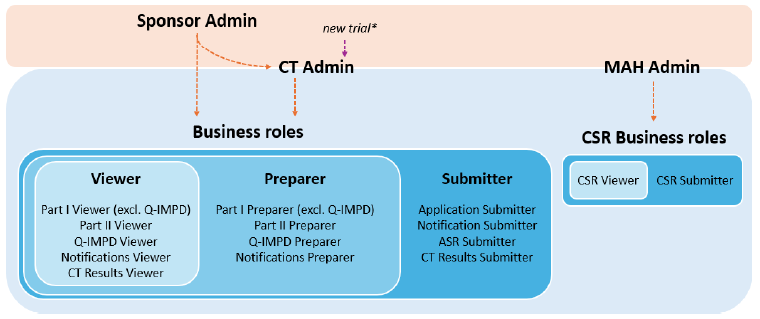
CTIS user roles fall into administrative roles and business roles. Administrative roles (Sponsor Admin, CT Admin, MAH Admin) may assign other business roles within CTIS. Business roles grant permissions to view, create, update or complete specific tasks across the full clinical‑trial lifecycle.
Sponsor Admin (Sponsor Super‑administrator): The highest‑level organisational administrator, applied for via the EMA Account Portal. Responsible for assigning all permissions within the organisation. This role itself carries no trial‑operation privileges; corresponding business roles must be additionally assigned to the account. It is recommended to appoint at least two personnel for this role to mitigate risks arising from single‑person turnover.
CT Admin (Trial Administrator): Authorised to assign all types of business roles for the given trial and holds most trial‑operation permissions.
MAH Admin (Marketing Authorisation Holder Administrator): Dedicated for viewing and submitting Clinical Study Reports (CSRs). Application shall be submitted to the EMA Service Desk; this role does not govern permissions for standard clinical‑trial applications.
Viewer: Permitted only to view and download documents; no editing access.
Preparer: May edit, upload and save draft submissions, but cannot perform formal submission.
Submitter: Combines preparer privileges plus full authority for formal submission and application withdrawal.
Practical Tips
Avoid assigning excessive overlapping roles to a single user, as this may trigger system anomalies. Grant only the minimum permissions required for job duties, and revoke unused permissions in a timely manner.
Key Takeaways
User management and role assignment within CTIS are complex and heavily dependent on hands‑on practical experience.
Beijing BrilliantMed Pharma Technology Co., Ltd. specialises in global pharmaceutical regulatory affairs and CTIS hands‑on operations. We support domestic enterprises with EMA account activation, SPOR‑OMS organisational registration, Sponsor Admin role application and CTIS permission planning. We resolve pre‑trial system‑configuration challenges for EU clinical trials, prevent project delays caused by inappropriate permission‑model selection, and facilitate the smooth European market entry of Chinese innovative medicines.